Product Description
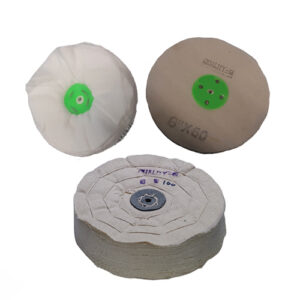
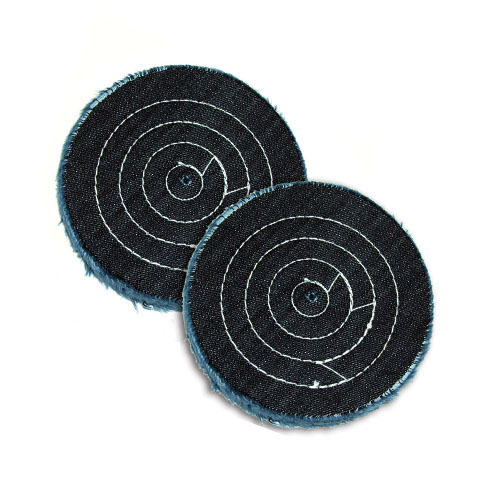
Your first polish which is usually more abrasive to get the scratches out – Best paired with Unipol blue polish . Follow with a softer buff with Unipol gold.
Sewn layers of cloth become more dense and strong lending themselves to “cut” the metal surface thus removing scratches and imperfections on the surface.
Stitched buff is suitable on harder metals.
Polishing and Buffing Wheels in Action
When brushes, buffs or wheels turn at high RPM on a polishing lathe, tremendous centrifugal forces cause walls to flatten and compact.
The walls of the wheel or buff flatten and become stiff and under the circumstances the face surface becomes uniform creating a flat plane to the contacting metal.
This force, as much as the wheel material and the abrasive applied gives the wheel its working qualities and produces the result.
When the wheel revolves, it turns toward the worker and exerts a downward pressure. It is important to bring the metal at a tangential angle then into sideways motion contact with the revolving wheel and only in the area of buffs forward lower quarter segment.
If the work is applied at any other section of the turning buff wheel the work will be torn from your hands by the opposing direction of the turning wheel. Injury or damage to work piece can be a consequence.
The problem of frictional heat is caused because two forces are at play. Pressure and RPM. Greater pressure or higher RPM imply increasing heat. Metal is a good heat conductor.
Excessive pressure removes too much metal to be worn away = monetary loss. Your binder or abrasive will also burn a glaze onto the buff spoiling it permanently.
Solutions include wearing rubber finger cots or leather cots to insulate. Minimise heat build up with short passes or intervals to allow brief cooling.
Wood ring clamp can hold work, wood is a poor conductor of heat compared to metal.